How We Pick Games
What we look for in a browser game, with examples from Slope, Rolling in Gears, and Two Ball 3D.
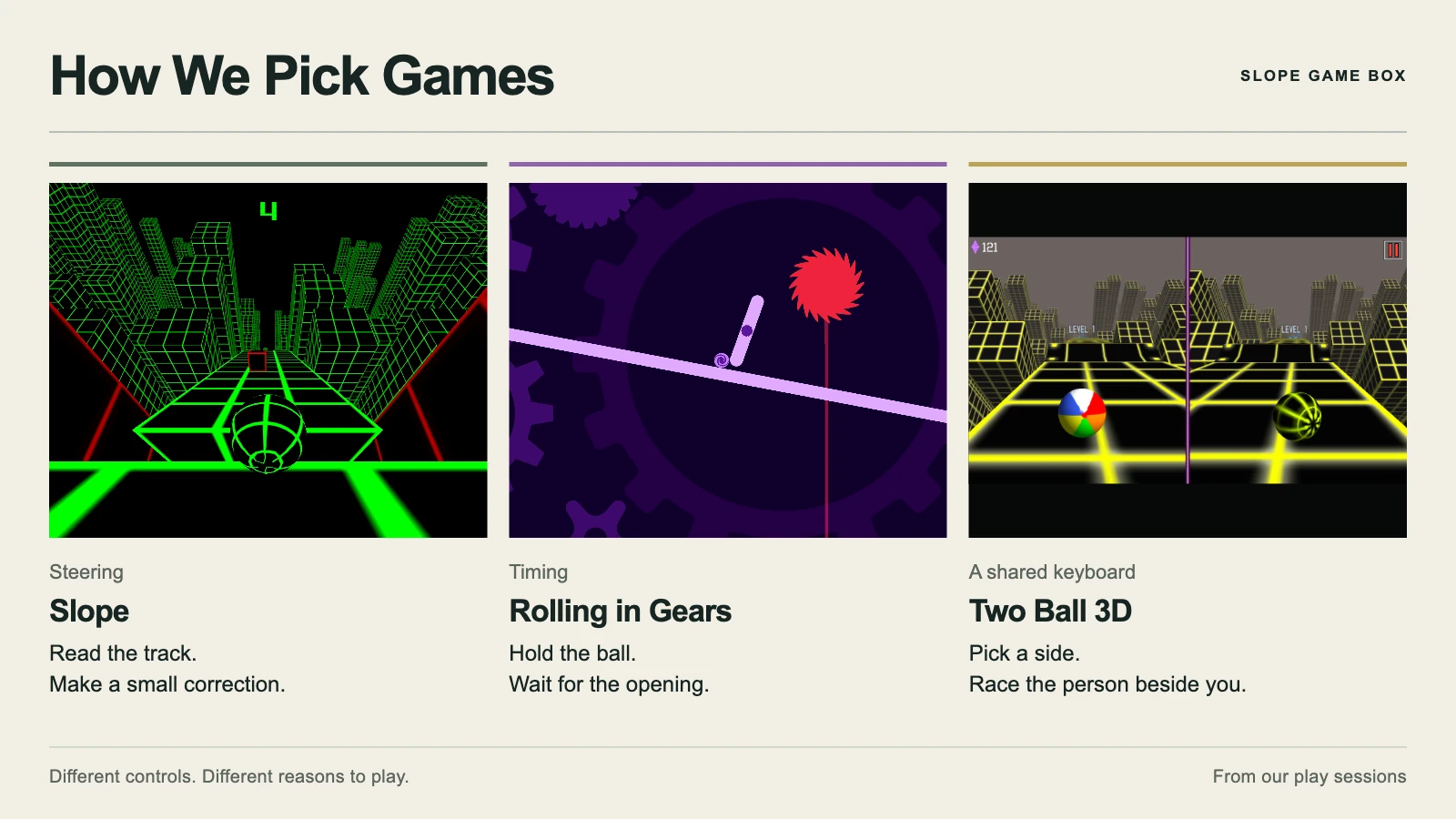
Slope and Rolling in Gears both put a ball on a course. In Slope, you steer it around obstacles while it keeps moving. In Rolling in Gears, you turn the machinery underneath it and choose when to let it roll. That difference matters more to us than the fact that both games fit under “ball games.”
We want the collection to give you useful choices: another fast run, a slower puzzle, or something to play with the person beside you.
What will you actually be doing?
We start with the controls and the decisions they create. A familiar-looking game can earn a place if it gives you a different problem to solve.
In Slope, a small correction made early can save a run. Holding a direction too long can carry you past the opening you were aiming for. It suits a short session of learning to read the track ahead.
Rolling in Gears asks for patience. In one early level, we held the ball behind a rotating barrier while a saw moved past. Releasing it at the wrong moment ended the attempt. Here, waiting is part of the move.

Two Ball 3D offers another reason to stay: two people can race on one keyboard. One uses A and D; the other uses the arrow keys. We describe that as local two-player play so you know what to expect before inviting a friend.
The first run is only part of it
We also check what happens around the game. Can we reach the start screen, understand the controls, and restart after a mistake? If an ad interrupts play, can we get back to the controls?
Rolling in Gears gave us a useful example. After an ad, we had to click back into the game before the keys responded. That belongs in the guide: otherwise, a working game can seem broken on your next attempt.
Enough detail to help you choose
A game page should tell you what makes this particular game worth trying and help with an early sticking point. We use our play sessions to explain its controls, modes, and a few situations you can recognise on screen.
That is also why the collection includes different speeds and styles of play. You may want another downhill run today and a puzzle tomorrow. Here is how those sessions become our guides.